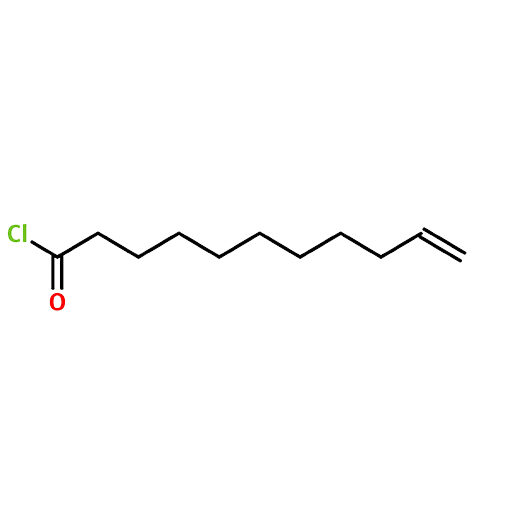
10-Undecenoyl Chloride, also known as 10-Undecylenoyl Chloride and 10-Undecenoic Acid Chloride, is an unsaturated acyl chloride with the molecular formula C11H19ClO and molecular weight of approximately 202.72 g/mol. Its structure combines a reactive acid-chloride functional group with a terminal carbon-carbon double bond.
The combination of these two functional groups makes 10-Undecenoyl Chloride a useful building block for preparing functionalized esters and other organic compounds. The acid-chloride group provides a convenient route for acylation, while the terminal alkene can provide a further site for subsequent chemical modification.
Synonyms - 10-Undecylenoyl Chloride; 10-Undecenoic Acid Chloride; Omega-Undecylenic Acid Chloride; Undec-10-enoyl Chloride; 10-Undecenoyl Chloride.
Applications of 10-Undecenoyl Chloride
Specialty Ester Synthesis: 10-Undecenoyl Chloride is used as an acylating reagent for converting alcohol-containing compounds into 10-undecenoate esters. The resulting molecules retain the terminal alkene, allowing further functionalization when required.
Polymer Chemistry: The bifunctional character of the molecule makes it useful in the preparation of functional polymer building blocks. Research has demonstrated its use for preparing unsaturated monomers and ester intermediates for subsequent polymerization and crosslinking studies.
Functional Polyesters: 10-Undecenoyl Chloride has been employed to prepare long-chain unsaturated ester monomers for polyester research. These monomers can contain terminal alkene groups that provide additional sites for subsequent polymer modification or metathesis chemistry.
Polymer Modification: The compound has been used to introduce long-chain unsaturated ester functionality into polymers containing reactive hydroxyl groups. Such modifications can introduce pendant alkene groups that are subsequently available for crosslinking or other chemical transformations.
Advanced Materials Research: Because the molecule contains both an acyl chloride group and a terminal alkene, it can serve as a molecular linker or functionalization reagent in research involving polymers, amphiphilic materials and other functional organic materials.
Organic Synthesis: 10-Undecenoyl Chloride can be used as a C11 unsaturated acylating building block in organic synthesis. Its reactivity enables formation of amide and ester derivatives from suitable nucleophilic substrates, while its terminal alkene provides an additional functional handle for downstream chemistry.
Research and Development: The compound is used in chemical research where a long-chain acylating reagent with a terminal alkene is required. Published research has demonstrated its application in the preparation of bio-based polymer monomers, crosslinkers and other functional materials.
Chemical Information
The molecular formula of 10-Undecenoyl Chloride is C11H19ClO, with a molecular weight of approximately 202.72 g/mol. Its IUPAC name is undec-10-enoyl chloride. The molecule belongs to the acid chloride class and contains a terminal alkene.
For pricing, technical specifications, commercial requirements or supply enquiries for 10-Undecenoyl Chloride, please contact B J Corporation.
Chemical Structure